Product FAQs
Is there gluten in Ghirardelli products?
- We understand that gluten sensitivity is a concern for many, and we want to ensure you have the best experience with our chocolates. While some of our premium chocolate products do contain gluten, either as a cereal ingredient or barley component, we also offer a selection of chocolates without the gluten-containing ingredients, making them a wonderful option for those with dietary restrictions.
- For your convenience, ingredient listings are available on our website. However, we always recommend checking the packaging for the most accurate and up-to-date information.
- We truly empathize with those who are currently unable to enjoy all of our chocolate offerings. Rest assured; we are continuously working to expand our range to better accommodate the diverse dietary needs of our consumer
Are Ghirardelli products non-GMO?
- As of January 1, 2023, the National Bioengineered Food Disclosure Standard requires disclosure of bioengineered (BE) food ingredients on labels. We are pleased to confirm that Ghirardelli chocolate and cocoa powders (excluding baking mixes and sauces) do not contain bioengineered ingredients and are not required to be labeled as such.
What is the cocoa content in your products?
- Most of our products do list cacao percentages right on the package. For the products that do not, however, the typical cocoa percentage is about 50%.
Do you use peanut/tree nuts in the manufacturing of your products?
- Ghirardelli Bars and Squares are made in a facility and on shared equipment with products containing the following tree nuts: almonds, pecans, hazelnuts, cashews and coconut.
- Ghirardelli chocolate chips (60% Bittersweet, Semi-Sweet, Mini Semi-Sweet and Milk Chocolate) are not produced on shared equipment that run tree nuts However, our chips are produced in the same facility that produce tree nut containing products.
- Peanuts are not used in the manufacturing facility for Bars, Squares, and 60% Bittersweet, Semi-Sweet, and Milk Chocolate Chips.
What is the gelatin source?
- Ghirardelli Chocolate Company is no longer using gelatin in the production of our products.
What is the caffeine level in your products?
- Caffeine is a compound naturally found in commonly consumed items such as coffee, tea, and chocolate. An average cup of coffee (8 fl oz) contains about 95 mg and the same amount of tea contains about 26 mg. Compared to these two sources chocolate has very little caffeine. The caffeine content of chocolate is dependent on the amount of cacao in the product. Dark chocolate contains about 20 mg of caffeine per ounce, milk chocolate contains about 6 mg per ounce, and white chocolate contains no caffeine. However, caffeine content will vary and can be dependent on the cocoa bean type and origin.

Can you make limited editions year round?
- Limited Edition flavors are only available for a certain times during the year. The Limited Edition program allows consumer to have a variety of tasty treats throughout the year, in addition to our standard line up of fine products.
Why has my favorite flavor been discontinued?
- Based on national sales we make tough decisions on discontinuations. However, feedback on the flavors is also appreciated and taken into account in future product developments.

Chocolate Substitutions
When you’re baking and you need to substitute one Ghirardelli product for another, try these options
- Ghirardelli Bittersweet and Semi-Sweet Chocolate can be used interchangeably.
- Ghirardelli Unsweetened Chocolate and Ghirardelli Chocolate Semi-Sweet Baking Bars: 4 ounces of Ghirardelli Semi-Sweet Chocolate equals 2 ounces of Ghirardelli Unsweetened Chocolate combined with 2 ounces of sugar.
- Ghirardelli Unsweetened Premium Cocoa and Ghirardelli Sweet Ground Chocolate and Cocoa: For each ½ cup of Unsweetened Premium Cocoa, use 1 cup of Sweet Ground Chocolate and Cocoa and decrease the amount of sugar the recipe calls for by ½ cup.
- Ghirardelli Sweet Ground Chocolate and Cocoa and Ghirardelli Unsweetened Premium Cocoa: For 1 cup of Ghirardelli Sweet Ground Chocolate and Cocoa, use ½ cup Unsweetened Premium Cocoa and ½ cup sugar. Mix together prior to adding to the recipe.
- Ghirardelli Unsweetened Chocolate and Unsweetened Premium Cocoa: For every 1 ounce of Unsweetened Chocolate called for in a recipe, use 3 level tablespoons of Unsweetened Premium Cocoa and 1 tablespoon extra of butter, margarine, or vegetable shortening than called for in the recipe.
- Ghirardelli Sweet Ground Chocolate and Cocoa and Ghirardelli Unsweetened Baking Chocolate: For every 1 ounce of Ghirardelli Unsweetened Baking Chocolate, use 6 level tablespoons of Sweet Ground Chocolate and Cocoa; add 1 tablespoon extra of butter, margarine, or vegetable shorting than called for in the recipe; and decrease the amount of sugar the recipe calls for by 3 level tablespoons.
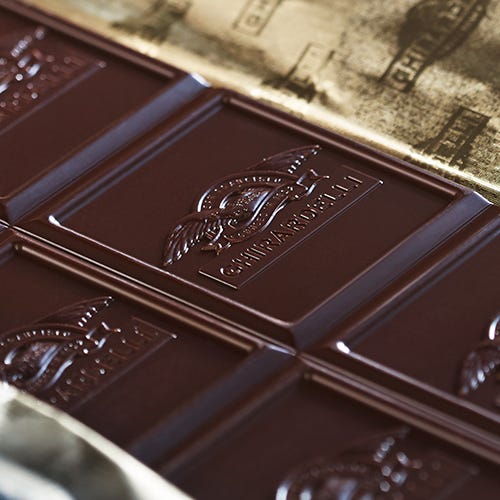
Chocolate Storage & Care
Love your premium-quality Ghirardelli Chocolate and it will love you back. Our experts share a few ins and outs for the storage and care of this special product, ensuring you enjoy your chocolate at the peak of it flavor and quality.
- Keep chocolate tightly wrapped and store in a cool, dry place at 60–75°F.
- Poor storage conditions will cause chocolate to “bloom,” or develop a light-colored powdery surface on the chocolate, caused by sugar or fat crystals rising to the surface. When this happens, the chocolate will still be fine to eat, but the texture will suffer.
- To prevent bloom, make sure the chocolate doesn’t get too warm or experience extreme fluctuations in temperature.

Where do our cocoa beans come from?
- Cocoa beans are the heart of our chocolates. Knowing which of the many different origins of cocoa beans will best contribute to the distinctive taste of a product is a skill that we have perfected over time. A fundamental distinction is made between consumer and fine flavor cocoa. Consumer cocoa is cocoa with a robust flavor. It accounts for the largest share (90-95%) of total global cocoa production and is farmed mainly in West Africa. Lindt & Sprüngli uses Forastero beans (consumer cocoa) from Ghana. The remaining 5-10% of worldwide cocoa harvests are fine flavor cocoa. Fine flavor cocoa is a high-quality cocoa with nuanced, fine aroma. It is mainly farmed in Latin America and the Caribbean. Lindt & Sprüngli uses fine flavor cocoa beans (Criollo and Trinitario) from Ecuador, Madagascar, Dominican Republic, Papua New Guinea and Peru. Our own sustainability program, the Lindt & Sprüngli Farming Program, is in place in all countries we source cocoa beans from.
- After achieving our goal to source 100% of our cocoa beans through the Farming Program in 2020, we extended the Farming Program to include cocoa butter from Côte d’Ivoire in 2021. These are major steps towards our target to source all of our cocoa products (beans, butter, powder, and chocolate mass) through sustainability programs by 2025.

What is Ghirardelli doing with regards to sustainable sourcing of cocoa beans?
- In 2008, we launched the Lindt & Sprüngli Farming Program in Ghana and in the subsequent years in all our other cocoa bean sourcing origins (Ecuador, Dominican Republic, Madagascar, Papua New Guinea and Peru) to support cocoa farmers, their families and communities. The three main objectives are to increase the resilience of farming households, reduce the risk of child labor, and conserve biodiversity and natural ecosystems.
Is Ghirardelli using palm oil and is it sourced sustainably?
- Palm oil, palm kernel oil, and their fractions are used in limited amounts in certain fillings of our chocolate. Lindt & Sprüngli buys less than 0.01% of the global palm oil harvest. While these products are important for their melting properties and for providing a neutral flavor, their production under uncontrolled conditions may be associated with environmental and social sustainability issues, including deforestation and conversion of peatlands, biodiversity loss, exploitation of workers, and adverse effects on local communities and Indigenous Peoples. However, palm oil can be produced responsibly when planted in suitable areas and with appropriate consideration for the environment and communities.
- Palm oil is a high yielding vegetable oil. In comparison to soybean, rapeseed and sunflower, palm oil needs significantly less land to produce the same volume. We recognize that banning and substituting palm oil with other crops would require more land to be dedicated to vegetable oil production globally, likely at the expense of natural forest land. We believe that the best way to protect and restore the rainforest and threatened habitats is to undertake actions for a more sustainable palm oil industry. For these reasons, we only purchase palm oil certified according to the Round Table of Sustainable Palm Oil (RSPO) [TK1] sustainable standard (in Europe: RSPO’s Segregated traceability level; in US: mix of “Segregated” and “Mass Balance”), and always declare palm oil use on our product packaging.